LAP_SoC: A Heterogeneous System-on-Chip with Lightweight Automata Processor
Published:
🚀 Project Overview
Multi-pattern matching is a fundamental but computationally expensive operation widely used in deep packet inspection (DPI), log parsing, and bioinformatics[cite: 1]. Traditional general-purpose CPUs and GPUs suffer from severe branch mispredictions and intensive random memory accesses when simulating finite automata (FAs).
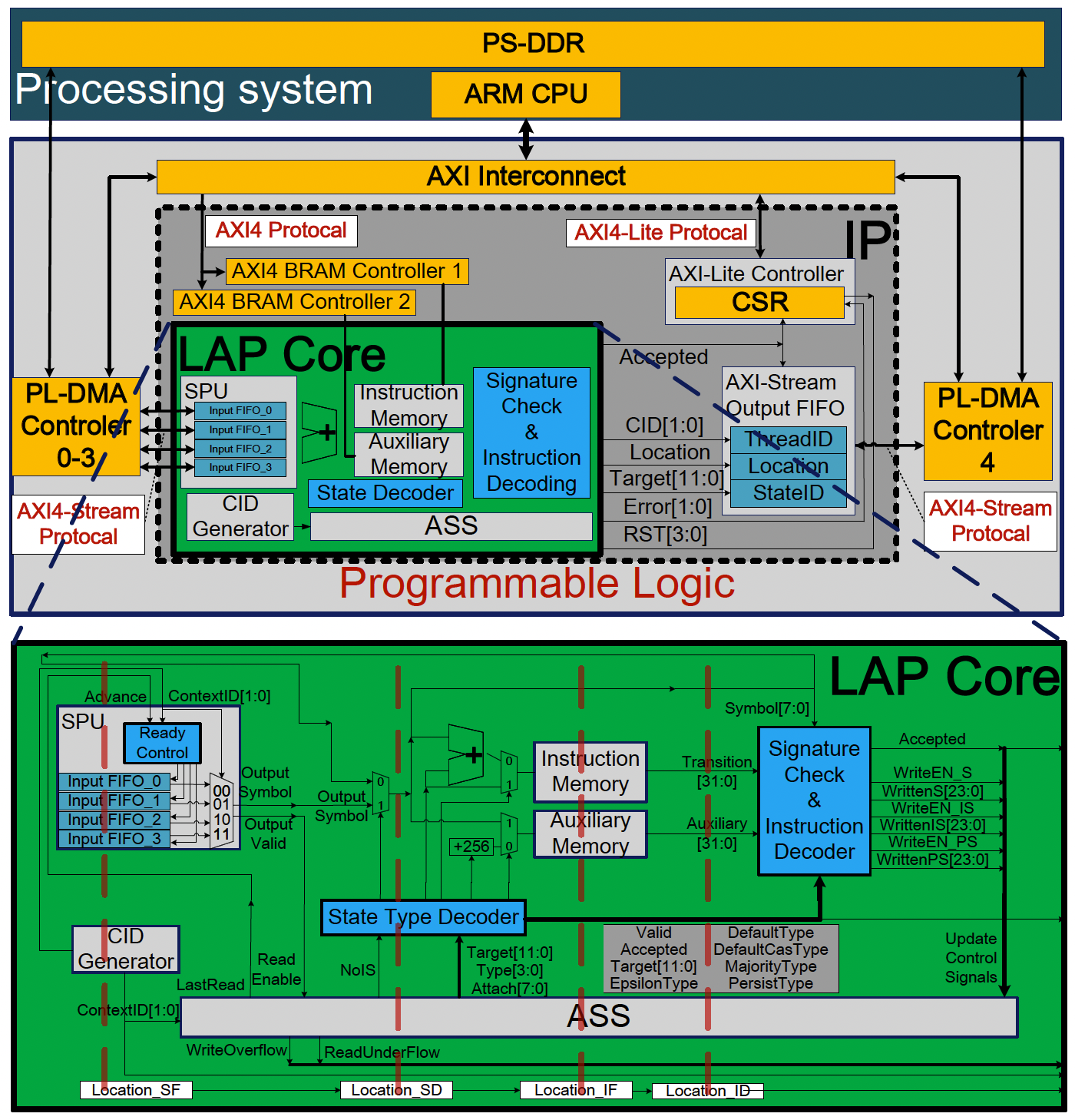
To tackle this bottleneck, I designed and implemented LAP (Lightweight Automata Processor), a domain-specific core optimized for ADFA (Amortized time/bandwidth overhead DFA) models. I further integrated this dedicated accelerator into an ARM-based heterogeneous Computing System-on-Chip (LAP_SoC) implemented on the Xilinx ZYNQ platform.
🛠️ Key Technical Contributions
1. Hardware-Software Co-Design & Parallel Rollback Architecture
To compress transition tables without ruining streaming performance, the framework compiles standard regular expressions into layered ADFA structures. By introducing a split storage topology, the core decouples regular labeled edges from fallback pipelines, executing state optimization with custom hardware primitives.
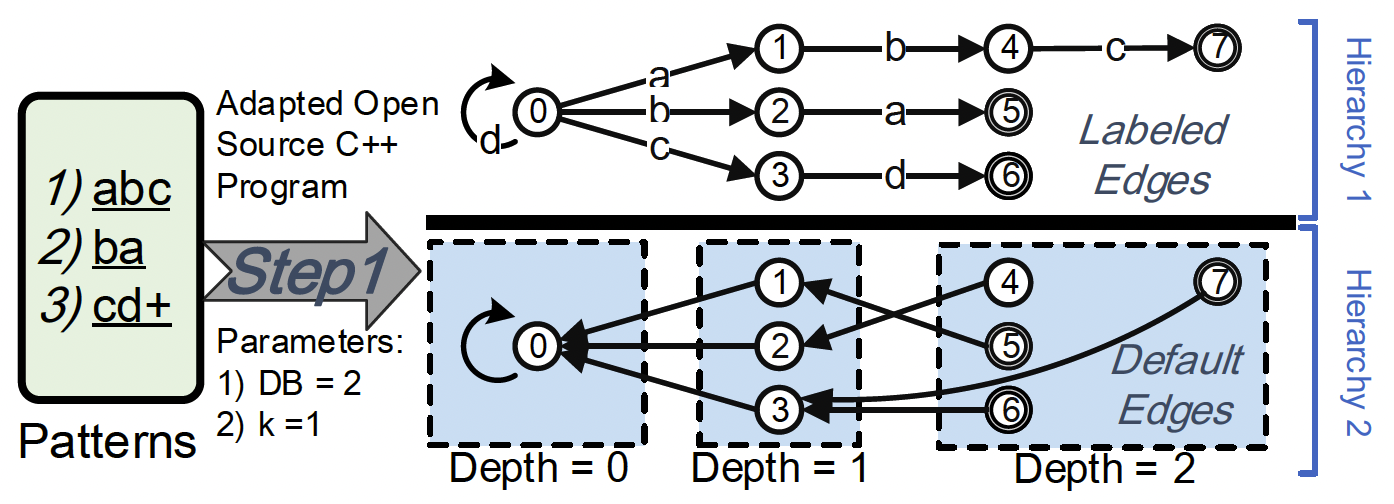
Figure: Layered compilation mechanism mapping standard patterns into compressed ADFA representations with tight bound limits.
2. Fine-Grained Multi-Threading Pipeline
Designed a highly balanced 4-stage hardware pipeline (State Fetch, State Decoding, Instruction Fetch, Instruction Decoding). To resolve data and control hazards without introducing complex bypass logic or pipeline bubbles, I implemented Fine-Grained Multi-Threading (FGMT), allowing 4 independent hardware contexts to share the core seamlessly with zero pipeline stalls.
3. Standard AXI Industrial Integration & Driver Stack
Wrapped the standalone LAP core into a production-ready Xilinx IP block featuring customized standard buses. Configured and booted an embedded Linux OS environment (built via PetaLinux) on the host dual-core ARM Cortex-A9 processing system. Authored the user-space low-level Linux drivers in C via mmap physical address binding, abstracting complex DMA descriptors into clean API primitives for seamless host-device scheduling.
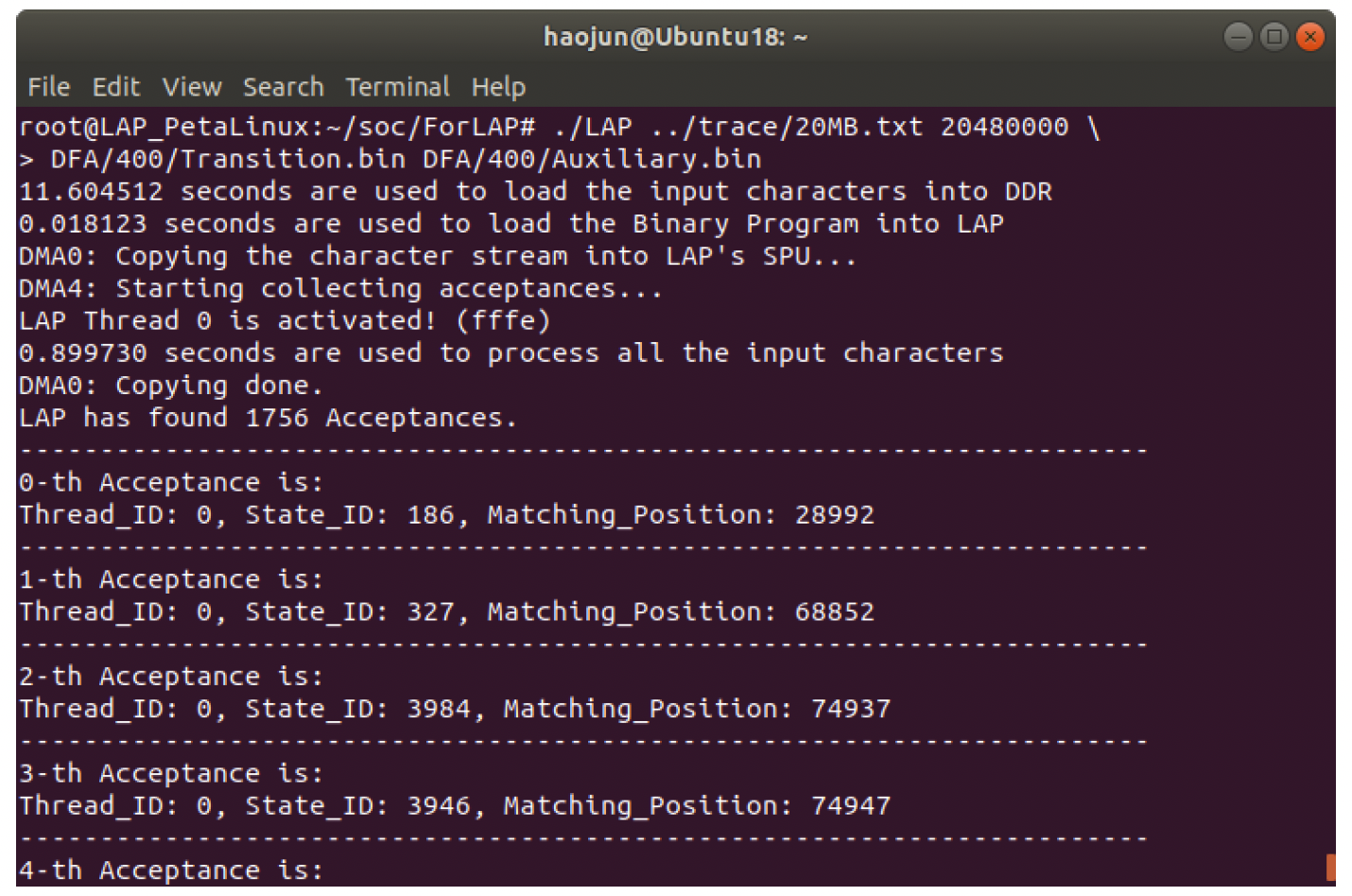
Figure: Live execution of user-space driver scheduling stream DMA copies and retrieving hardware match payloads.
📊 Hard Evaluation Results
- Silicon Efficiency: Fully synthesized and mapped onto the Xilinx fabric, achieving a layout clock of 263 MHz for the standalone core. The architecture provides up to 8x higher storage density compared to IBM RegX or Micron AP accelerators.
- Heterogeneous Speedup Dominance: In physical experiments, driving the hardware logic over unified streaming DMA buses provides massive latency drops. Compared to industrial-grade standard regex software engines (e.g., GNU
grep), LAP provides over 40x speedup against bare ARM processors and outperforms x86 server-grade Intel chips.
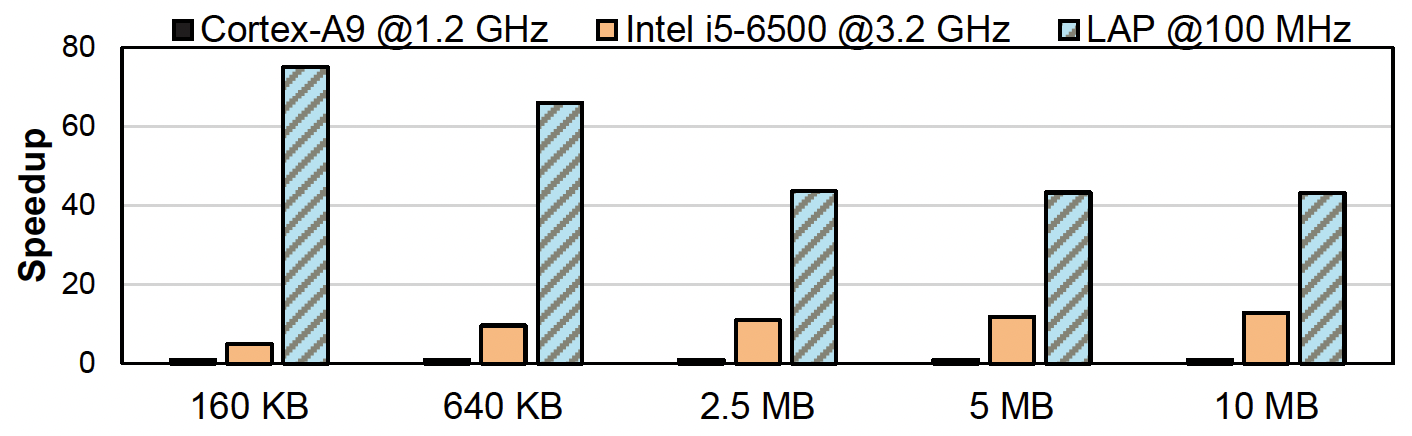
Figure: Speedup statistics across multiple dataset scales, illustrating constant performance scaling once OS overhead limits fade out.
🌌 Physical FPGA System Implementation
The entire heterogeneous compute platform is fully realized and validated on a standard Avnet Zedboard evaluation platform. The ARM processing subsystem hooks directly into the PL logic via memory-mapped interconnects to drive automated packet capture and deep evaluation pipelines.
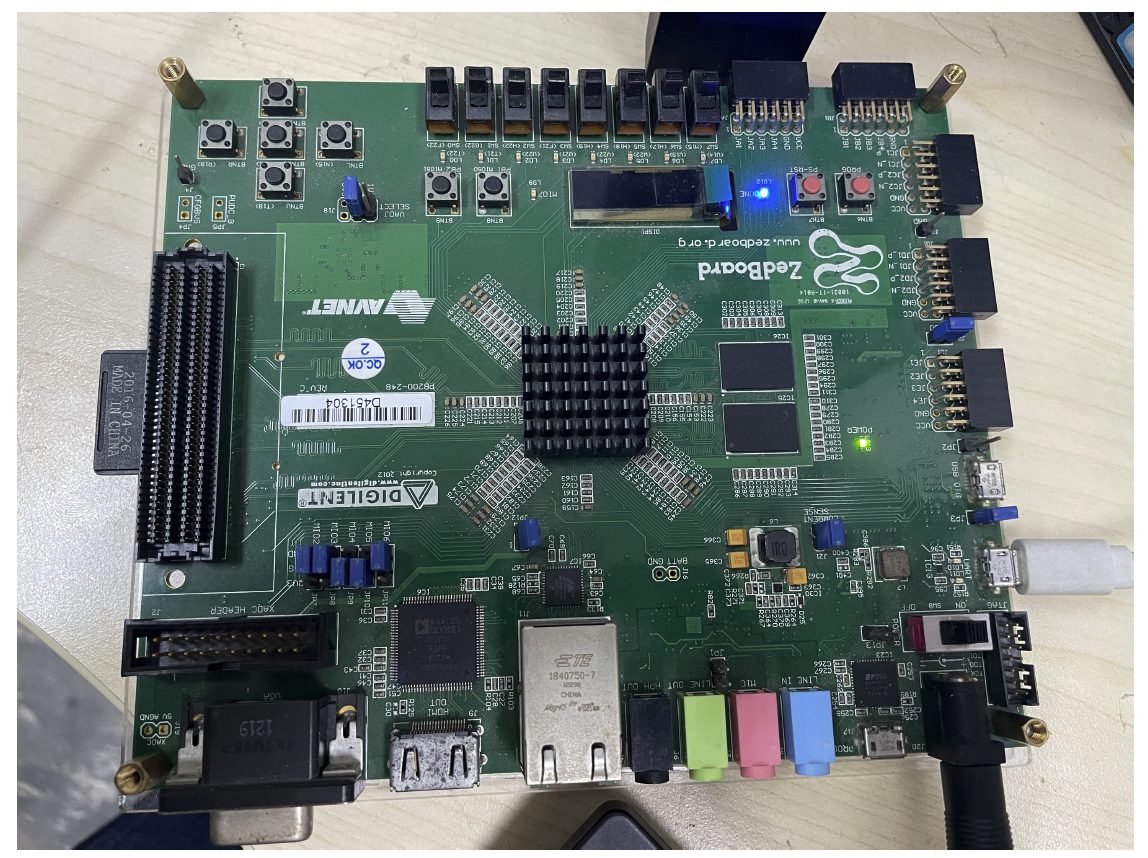
Figure: Physical experimental setup of LAP_SoC running embedded Linux environment and real-time streaming validation.
📝 Related Publication
This full-stack project led to my master’s thesis at USTC and a peer-reviewed publication:
- Haojun Xia, Lei Gong, Chao Wang, et al. “LAP: A Lightweight Automata Processor for Pattern Matching Tasks.” In Proceedings of the 2021 Design, Automation & Test in Europe (DATE). (CCF-B)